Advanced QM Lists
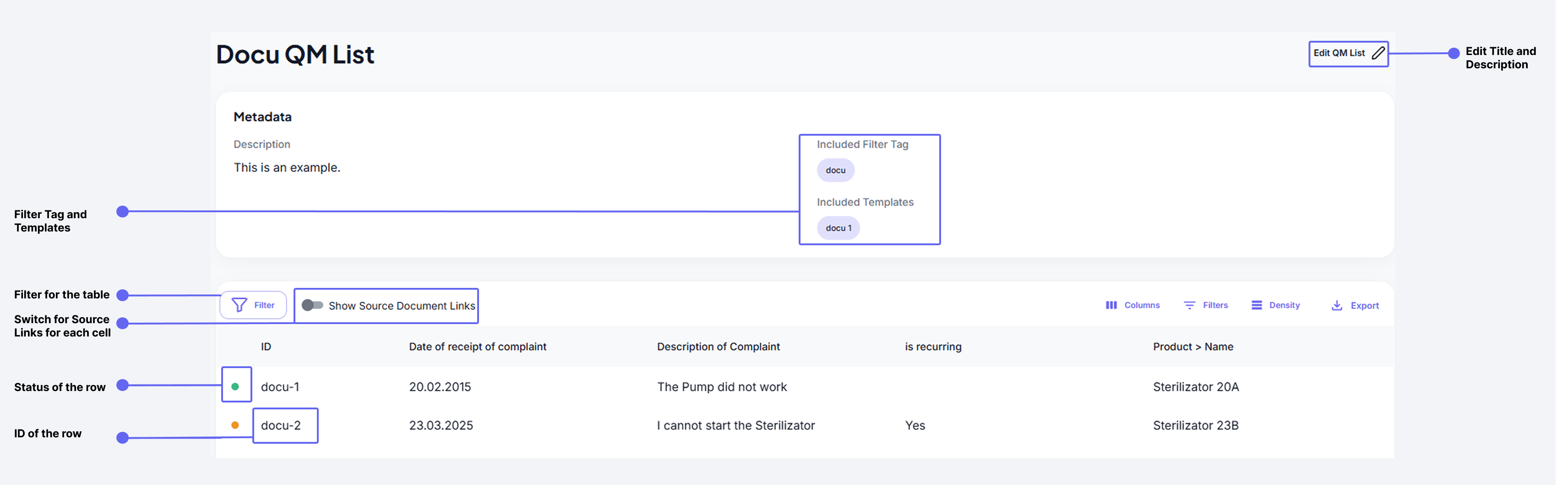
A QM List consists of several key components:
- Title and Description: Each list has an editable title and description to help identify its purpose
- Filter Tag Connection: If set, the list is based on Filter Tags and groups Documents by the Case IDs defined for that Filter Tag.
- Template Connection: Lists are connected to a specific template, displaying data from all documents using that template
- Table View: Data is presented in a table format where:
- Columns represent input fields from the template
- Rows show individual documents and their data
- Filtering Options:
- Use the date-range filter to narrow down your view
- Use the additional filters on the right to disable columns or set specific content a column must contain.
- Save the filter t build completely customizable QM Lists needed for you Audit!
- Export Data: Export data as a csv or xlsx file, apllying all previously specified filters.
- Source Links: Toggle the switch button at the top of the table to enable document links, allowing you to quickly navigate to source documents
- Status: The dot shows whether the document(s) are locked (i.e finalised) or if there are still open documents.
- ID: The ID column shows on whihc document or Group (of documents) the row is based on.
Working with a Multi QM List
A Multi QM List allows you to view and manage data from multiple related documents in a single table view. This is particularly useful when you need to track information that spans across different document types that are logically connected.
Key Features
-
Filter Tag Based Organization
- Only templates with the specified Filter Tag can be included in the list
- Documents are automatically grouped based on their Filter Tag Case ID
- Related documents appear in the same row for easy comparison
-
Data Display
- Each row represents a group of related documents
- Columns show data from different fields across the connected documents
- Source links in each cell take you directly to the specific document containing that data
-
Status Tracking
- Visual indicators show whether all documents in a group are finalized (locked)
- Easily identify groups with pending or open documents
-
Document Identification
- Each row displays either a single document ID or a Case ID
- Quickly locate and reference specific documents or document groups
info
For further details on how to create and assign Filter Tags or Case IDs please see [Templates](../3. Document and Template World/templates.md) or [Documents](../3. Document and Template World/documents.md)
Best Practices
- Use Filter Tags consistently across related templates to ensure proper grouping
- Regularly check the status indicators to track document completion
- Use source links to verify data directly in the original documents
- Group related documents using the same Filter Tag Case ID for optimal organization
- Regular reviews of your lists help maintain data organization